Many thanks to Stephen Mudd who is the Historian and Author
of this excellent document originally produced by David and Doreen Sheppard in
May 1994
More Than Just
A Football Team
Well here we are nearing the completion of our publication on the history of the
Leeds Cougars, and having read the complete story to date you may be surprised
to find an extra chapter tagged neatly onto the end. What more can be said which
could add to the story? Well the Cougars are much more that a senior football
team and any publication detailing the history of the club would not be complete
without a brief mention of the other groups which fall within the general
umbrella of the Leeds Cougars. Football is now so much a way of life to many
people that it was only natural for groups of fans to form various organisations
in order to enhance their enjoyment of the game, and the following briefly
describes a few such groups:
Leeds Cougars Juniors
Info just in
from Paul Anderson : The actual way the Juniors formed was by a phone
call to myself from Pete Simpson asking me if my
Junior team would like to go up on a cold Autumn Sunday afternoon for training .
My team the Pudsey Patriots with
about 30 players went up and once Pete realised there was enough youth interest
asked if our team would change its name to Leeds Cougars Juniors and form the
beginning of the Juniors which went on one year later to win the Junior
Super bowl 42 nil against the Manchester All stars Juniors at Wigan St
pats ground ( When Dave Hadden was the coach )
He then
advertised for any other young players to come down to Soldiers Field .
Other info
from Paul : I was the first Junior to come through the ranks and make the
seniors I was Quarterback for the J cougars in 86 when we won the JuniorSuper
bowl 42 nil against the Manchester All stars Juniors at Wigan St pats ground (
When Dave Hadden was the coach ) . I graduated up in 88 as a third string QB but
to get game time and so to learn more I stareted out at Corner back #22 and was
given individual training by Dan Moore as because of my age at the time he took
me under his wing the next person to move up was Steve Newton LB( his nick name
was Blue given to him by Dan Moore on a coach ride back from playing the
infamous London Ravens which I think we lost 26-6 if memory serves me right )
Info below is from the original source again :
With football becoming established in the UK within the very early seasons it
was an obvious step to set up Junior sides as young supporters began to take the
game seriously and expressed their wishes to play competitive games rather than
to be content in watching the action. Teams began to recognise that Junior sides
would be the way to ensure teams continued to thrive, as they would provide the
youngsters with much needed experience, enabling them to graduate to the senior
side and thus provide continuity of players for future years. Of course,
organised competitive football would also provide the youngsters with the
required level of safety and hopefully prevent serious injuries which could
occur if games were not properly supervised
And so it was at the Cougars that in 1985, following advertisements in the
senior game day programmes, a group of young enthusiasts got together to form
the Cougar juniors, in the hope of catering for those too young to compete in
the senior game. With senior football still trying to find its feet and become
established it was therefore natural that the initial year was spent learning
the games basics, under the watchful eye of many senior players. The initial
training sessions attracted a large turnout of hopefuls but as we have heard
with the seniors, the training routines and weather soon saw the numbers trimmed
to the hard core of truly dedicated footballers.
Dedication was to be the foundation on which the team was built and 1986 saw the
Cougars playing in the Junior American Football League (JAFL) where, under the
coaching of Dave Haddon, they made an immediate impact on the game. The idea of
the juniors was to allow the youngsters to emulate their heroes and so it should
have been no surprise when they really did the club proud by becoming Northern
Champions, with a team featuring players who were to become well known in years
to come, names such as Steve Newton, Richard Hanby and John Williams to mention
a few.
The Junior game in general was on the increase, and in keeping with the senior
game there were many ideas concerning just which way the game was to progress.
Clubs were being asked to make decisions with no real long term plans, and so in
1987 the Juniors declined to play in the Two Touch League as they concentrated
on their preparations to play full kitted competitive football. A year out of
the game could have proved disastrous, but with the coming of the British Youth
American Football Association (BYAFA) in 1988 the Cougars showed they had not
been wasting their time. Continuing to build on the success of 1987, and under
the guidance of new Head Coach Pavlo Andrusiak they proved to be one of the
great forces within the Junior ranks, on their way to finishing the season
ranked third nationally.
As with all teams there comes a time where circumstances change, leaving members
fighting battles off the field as well as on it. These are the days when playing
standards do not live up to expectations, and so it was in 1989 with the team
having an in and out year which saw the squad almost fold due to lack of funds
and players. Thankfully
the problems were short lived as 1990 heralded a resurgence, and a new
management/coaching team plus many new players saw the start of a new era of
youth football in Leeds.
Since 1990 the Cougars Junior side have played 41 games to post a 26 - 12 - 3
record, as once again they are recognised as a force within the game. A
particularly impressive 14 - 4 - 2 Home record has left opponents under no
illusions as to just how hard a game they, face, despite the usual warm and
hospitable Yorkshire welcome. The club have reached the play-off stages of
competition every year with the exception of 1993, when by a strange quirk of
fate they posted their best season record (6 - 2 - 0) but still missed out.
Solid football has laid the basis from which to move forward with 1991 producing
a well deserved divisional championship in a season which saw several players
honoured. Playing for the Great Britain Crusaders, Simon Dwyer Hayden Rawson and
Daz Milner become part of history as the squad became the first to beat American
opposition when they were victorious 39 - 9 over Lakenheath High School and 40 -
14 over team USA
Success has not been limited to just these shores as Simon Dwyer has since gone
on to play and study in the 'States and in 1992 several of the Cougar Juniors
went Stateside with the Crusaders. With Stuart Cliff, Darren Kerwick, Paddy
Michaud, Hayden Rawson, Simon Oliver and Ian Rutherford making the trip in 1992
and Stuart Cliff, Duncan Milner and Stuart Ennis included for 1993 the Junior
side has been well represented at International level.
The adjustment between the senior and junior football is often underestimated,
but the Juniors produced by the Cougars seem to have little difficulty in
making this step. The fact that so many seem to make the grade must bear
testimony to the commitment dedication and skill of both players and management
alike as Steve Newton, Peter Brook Simon Dwyer, Paul Goodward, Rob O'Reilly, Mark
Sephton, Richard Hanby, Graham Hanby, Richard Heighton, and Craig Barningham have
all made the grade.
The prospects for the future also look rosy with Paul Hoiden
and Anthony Dean currently training alongside the seniors as they hope for their
breakthrough into the senior ranks, and the next couple of years will see even
more coming through.
Players close to the end of their Junior years include
Duncan Milner, Stuart Cliffe, John Newman, and Paddy Michaud with each one of them
sure to press for senior squad recognition, as will Darren Kerwick and Daz
Milner (current), coaching and playing Defence at the University of Teesside
once they finish their College days.
In 1994 the Juniors will once again play competitive football with Home games
taking place at Fearnville Sports Centre. The season will follow the senior
season, running from August to October and any senior fans who have not yet
witnessed the excitement and commitment of the youth squad need only turn up to
be assured of a warm and friendly welcome.
Leeds Cool
Cats.
As with all football clubs there comes a point when supporters, who are
hopefully growing in numbers, begin to demand more information regarding the
players and club in general. The Cougars were no different as the initial games
in 1984 generated the interest from which to launch a Supporters Club, through
adverts in the 1985 season programmes, which promised information of the club,
players and souvenirs. So initially running the club themselves the Cougars
began to recruit the basis of the membership which was to build into the Club
which thrives today under the name of 'Leeds Cool Cats'.
Information in the early days tended to be on a 'need to know' basis with small
sections of notes in each game day magazine as the Club offered discounts on
merchandise and travel as major benefits. Continuing to run the supporters club
into 1986 saw numbers if members settle around the 40/50 mark before a
concentrated recruitment drive increased that number to well over a hundred for
the start of the 1987 campaign, leading to the Club becoming a separate
operation from the football team.
Naturally a successful football club will
attract more fans, and so following the excitement of the Premier Division
season the membership grew steadily throughout the initial National Division
season of 1988 to reach a peak towards the end of the 1989 season which saw the
Cougars fall only one game away from Bowl glory. Unfortunately, numbers since
have fallen as team performances have often failed to live up to expectations
and today the supporters club consists of the real hard core and long term
supporters.
With numbers increasing there became a need for more information to be passed to
fans during the now regular monthly meetings and so, in March 1988 the first
edition of the now long running Newsletter saw the light of day. Produced by
various individuals the Newsletter has gone from strength to strength and
contains a great variety of information as it attempts to keep all abreast of
happenings in and around the club.
The years have seen many individuals freely giving time and effort in a variety
of ways with the aim of helping the club to support the Cougars. These
individuals are too numerous to mention and to single out a few would be unfair
Suffice to say that all efforts have been appreciated and each one has made
their own unique mark on the history of the Cool Cats.
We are renowned for being one of the best supported clubs in the country. The
Cool Cats travelling army often outnumber the Home supporters. They are well
respected and received throughout the length and breadth of the country as being
knowledgeable and fair, always ready to accept and acknowledge good play from
both their heroes and their opponents, even though one or two officials do not
have the knack of giving decisions which the fans feel to be correct? Obviously,
like all fans, they prefer to see their team winning, but even when times are
not quite so good they continue to encourage their team throughout the hard
times. Good friends have been made on away travels, and the fact that so many
teams like to engage in fixtures against the Cougars is testimony to events both
on and off the field.
The Cool Cats pride themselves as being part of a club which constantly works
with the aim of helping the football team to be successful as they raise much
needed funds through raffles, functions, jumble salesetc., currently
working towards the raising of an initial £1000 to enable the Cougars to bring
over an American Quarterback to lead their 1994 campaign, the club members have
played their part in helping both senior and junior squads in the past as once
again we see all portions of the club working together towards the common goal.
Regular meetings have always been part of the supporters club philosophy as this
enables people with a common interest to meet socially throughout the year to
talk about both the domestic and American games. Regular guest speakers plus the
attendance of coaches and players allow fans to raise any questions or
observations and answer queries. Membership of the club is open to any genuine
supporter and the regular monthly Newsletter will keep members informed of all
the news within the club even if they cannot attend the meetings. The youngsters
are not forgotten either as the under 16's are enrolled in their own
Kitten/Young Cat Club.
Currently the supporters club holds its meetings on the first Wednesday of the
month in the clubhouse at Farsley Celtic FC and anyone thinking of joining can
pop along to any meeting where they are assured of a warm and friendly welcome.
So come on! Don't just sit in the stands and moan, come along and have your say
on anything you feel could be improved, after all, you only get out of the game
what you put in!, and the fans have as big a part to play in the success of the
team as do the players.
Leeds Blue Cats.
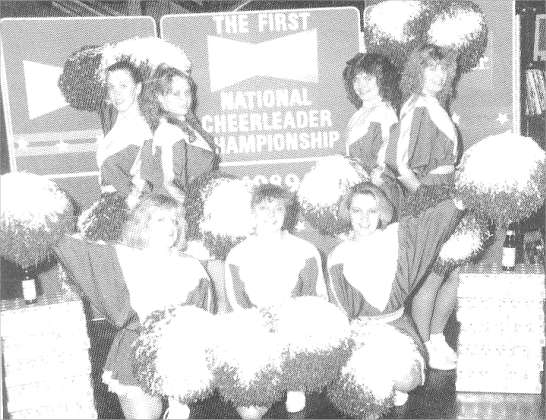
Give me a C, give me an 0, give me a U, - you've got it! The Leeds Blue Cats are
the Cheerleader squad on the sidelines at all Cougar games as they attempt to
encourage the players and supporters with their well rehearsed routines. They
are a welcoming sight and are every bit as dedicated as the men they cheer on.
As long as I can remember they have always been there, not always the same
faces, and on one occasion they went under a different name (does anyone
remember 'The Chuckettes'?) but nevertheless the blue and gold colours have a
reassuring air about them.
With the advent of the game in this country, female fans, wives and girlfriends
of the players began to follow the domestic game, having seen the American
version on television. The razzmatazz of the American game was an obvious big
attraction and wishing to become more involved many teams suddenly found
themselves with Cheerleader squads as the girls attempted to become part of the
action. The girls carry out their duties for the pure enjoyment of the game and
there's a big difference between cheering for a team on this side of the
Atlantic to cheering in the 'States. The whole business is better established
over there and to some extent is built on glamour.
Cheerleaders can use their
time on the sidelines as a stepping stone towards advancement in their careers,
and it must be remembered that Cheerleading for the NFL teams is a full time
paid profession. On the other hand, the British Cheerleaders art is still in its
infancy and it's not particularly glamorous as yet, although the lost few years
have seen the emergence of competitions and championships in an attempt to gain
public awareness. Conditions are not particularly good, with little in the way
of sponsorship which, as the girls mostly have to finance themselves, bears
great testimony to their dedication and commitment.
Sitting in the stands it is all too easy to dismiss the Cheerleaders as just
another part of the games entertainment but next time you see the Blue Cats in
action spare a thought as to just what it takes to be a member of the squad.
Basically it takes a lot of commitment, a lot of time and a lot of hard work.
Regular practices have to be attended, routines and chants have to be learned
thoroughly and they have to be fit with a lot of stamina - Remember, the
Cheerleaders are in action for the full sixty minutes plus pre-game and
half-time routines! All this would be hard enough, but then they have to have
the confidence to carry out the routines before a large boisterous crowd,
wearing what can only be described as a rather skimpy outfit.
Things do not
always go according to plan either, as more than once the music for a routine
has been mis-cued and a recent survey on the weather indicates that the best
days fall mid-week with the odds for the worst weather being heavily stacked in
favour of Sunday. The Blue Cats can surely confirm this as the number of times
they perform routines in the pouring rain are too many to recount but true to
the dedication shown throughout the club they just get on with the job in hand.
The girls need to have a basic knowledge concerning the game as only those who
understand what is happening on the field can realise when that little extra bit
of encouragement is required or when they need to keep quiet, as in the case of
injuries.
Many teams have seen their Cheerleading squads lose interest with the result
that they have ceased to operate, an action they must now surely regret.
Travelling squads of Cheerleaders are now being hired for games, but with no
specific allegiance to the team how can the fans identify with them? The
Cougars on the other hand believe in complete integration of all elements and
the Blue Cats have become part of the family, well liked and respected. They
have appeared at various functions and events as they continue to publicise
themselves and the team, and they have even been asked to Cheer at the Home
Games of Leeds United FC.
In conclusion, the Blue Cats are every bit as important as all the other
segments of the club although they don't always receive the recognition they
should. Hopefully we have outlined the hard work and dedication required, so the
next time they go through their routines let's give them the hand they deserve.